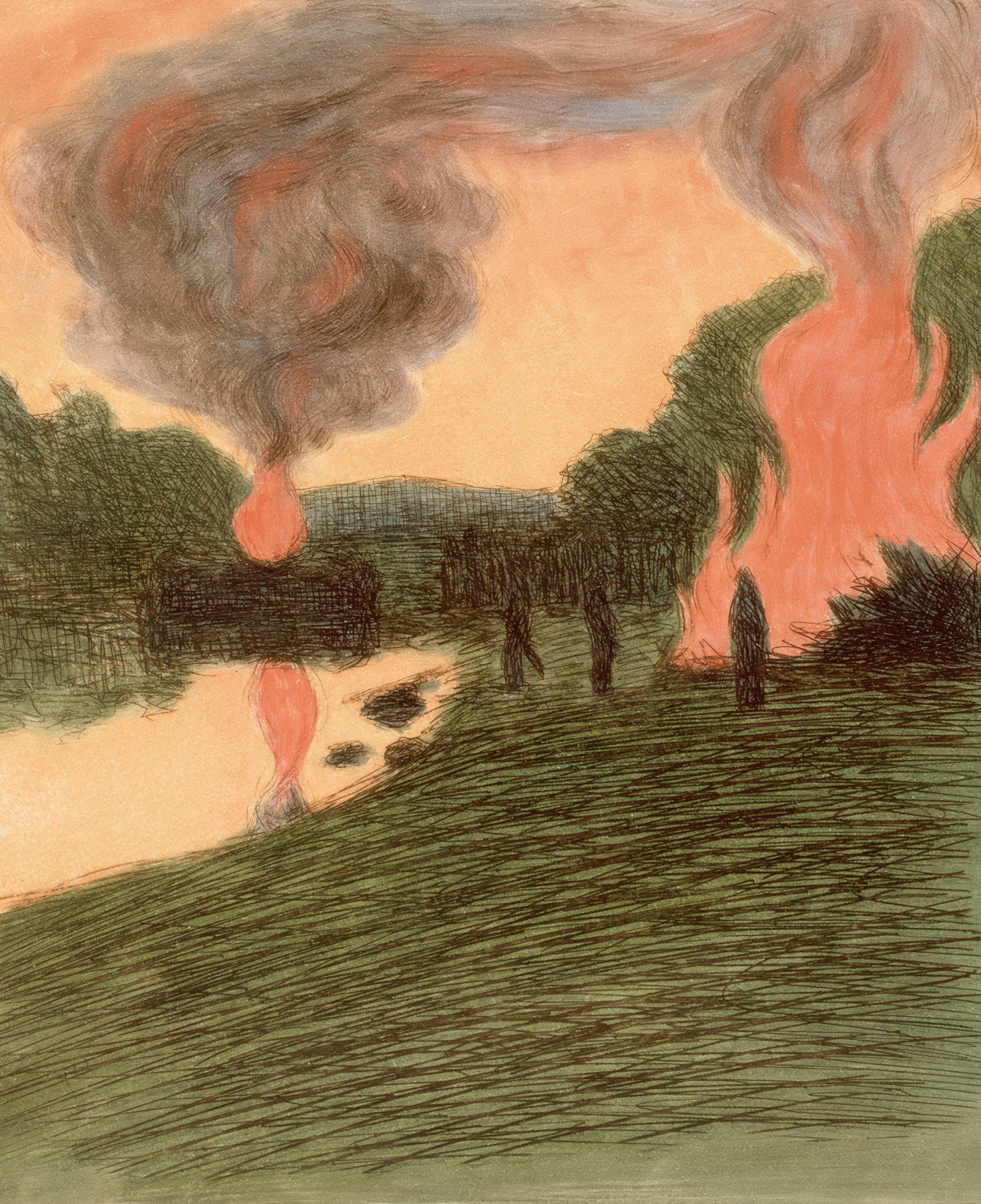
Africatown, Alabama. 1867
The first time I set fire to a field was when I was just about twelve years old.
My eyes were fixed on my hands. The skin on the tips of my pinky finger had lifted. I turned my palms over, tracing the lines that were caked in dry dirt. How did Mama Mandisa not tell that her crops were dying? The soil was rejecting the seeds. And yet, from morning till evening, she had me plucking weeds in the field that were choking out the indigo crops. Mama Mandisa cursed it, calling the vines “creeping indigo”. The weeds flourished more than what had been planted, sprouting delicate pink flowers as our crops drowned under them.
By evening, Mama Mandisa called Mr. Oluwale to her yard. I leaned against our house,
caked in dirt from head to toe, watching Mama Mandisa and Mr. Oluwale pace the dying land.
Mr. Oluwale dug his long, brown fingers into the dirt. He commanded the crops to come alive. But I saw, in what I think was a vision, weeds tangled and eventually our crops wilting. The soil was so cracked and dry that nothing could ever be planted on it again.
Mr. Oluwale removed his hand and assured us that our indigo would flourish. But Mama Mandisa shook her head, skeptical of his prophecy. She turned to me.
“What do you think, Agojie?”
In those days, it was uncommon for a child to be asked what she thought. I looked up at
Mama Mandisa. Her body was wrapped in a quilt-like dress that she had sewn together with her own hands- I had watched her do it. Her cheekbones, like mountains, cast shadows on her lips. She sucked her teeth at Mr. Oluwale before bending down to meet my eyes. I remember when I always thought she would always be bigger than me, more imposing, more woman.
“Will the indigo grow?” She asked, bluntly.
“No, Mama. It will not grow.”
And with those words, the sun finally set- claiming it’s place under the Earth. I could
almost feel its heat rising off the soil under me. I was barefoot, sinking my toes into the
dying ground. There were also days when I thought I’d always be a dirty little girl. I cowered in front of her; the only Mama I’d ever really known in this life.
“E nyɔ́.” It’s okay. She mumbled in Fon, kicking up the Alabama dirt in front of us.
Mr. Oluwale sucked his teeth.
“Jeji,” He said, rolling his eyes. It was the word that Oyo people called the Fon. “Why call me out here if you rather ask a child?”
Mama Mandisa crouched down in front of me, letting her knees dig into the dirt.
“Vǐ ce nyɔnu,” My daughter. I gulped in her words, knowing she didn’t birth me, “What did you see?”
The night before, I saw a woman in my dreams. She was taller than me, shoulders smoother, belly rounder. I had a feeling she was my real Mama. In the dream, she stood in a dying field. Rotten fruit fell at her feet. But I couldn’t see her face.
The woman reached her hand into the ground, but the soil was so dry, it ran through her fingers like gravel. In a moment, she set a stick on fire and threw it into her own field, watching everything burn around her.
And somehow, ahead of us, there was farm land that extended for miles; thousands of houses, thousands of families that were also looking over their fields. They left their houses and stood in front of their rancid and rotting fields. One by one, the other families set fire to their own land, bringing death upon their crops. There were fires everywhere; they extended across continents.
This is all I thought about when Mama Mandisa asked me what I saw.
“Last night, Mama Mandisa, I dreamed the field was on fire.”
Mr. Oluwale jumped back in fear.
“This child!” He said, shaking his head.
But Mama Mandisa smiled and squeezed my shoulders. She bent down in my direction,
letting the fabric of her dress brush up agaisnt mine. She kissed both my cheeks.
“This child knows the old way.” She whispered.
Mr. Oluwale came from a line of royalty (at least that’s what he said). It gave him the
belief that he could command the land to make bountiful crops. It allowed him foresight and better judgment. He even claimed that God was more inclined to answer his prayers because of his royal bloodline. He owned a general store in town, where he preached to folks behind a wooden counter-, whether they wanted to hear it or not.
But Mama Mandisa came from a line of farmers from the countryside. They were rugged peasant people. Before she was brought to this land on the Clotilda ship, she remembered how her Mama used to set fire to their cassava crops when the soil would start to dry up. Every crop had its season. Her whole family, she told me later, used to watch the smoke disappear into the canopy of surrounding trees. It was completely dark, except for the burning fire. In the morning, the ash would nourish the soil, allowing them to alternate crops. The dead brought life, “As it often does,” she would tell me.
Of course, Alafin Oluwale didn’t know nothing about that.
So, Mama Mandisa shooed him off, and we both watched him leave our property, shaking his head, kicking up the dirt in front of him. He mumbled about wayward women on his way out and the changing times.
“Olodumare, ran mi,” Almighty God, help me - he said in Yoruba. Mr. Oluwale turned his nose up to the evening sky, waving away mosquitoes. His eyes were fixed on the night sky, as if God was looking directly at him from behind the clouds. “You see your children? Now, women want to be men and girls want to be women!”
Mama Mandisa laughed, with her head all the way back. She looked up at the sky, too. The night surrounded her, enveloped her in its unusual warmth.
“Only God knows.” She said, closing her eyes. “Only God knows.”
Copyright (c) 2025 Amara Evering